
We are thinking about different aspects of drama or theatre or performative methods. It will published from time to time. Ideally, this will develop into a dialogue, allowing readers to contribute and express their views. A moderated link will be provided for this purpose.
COMMENT
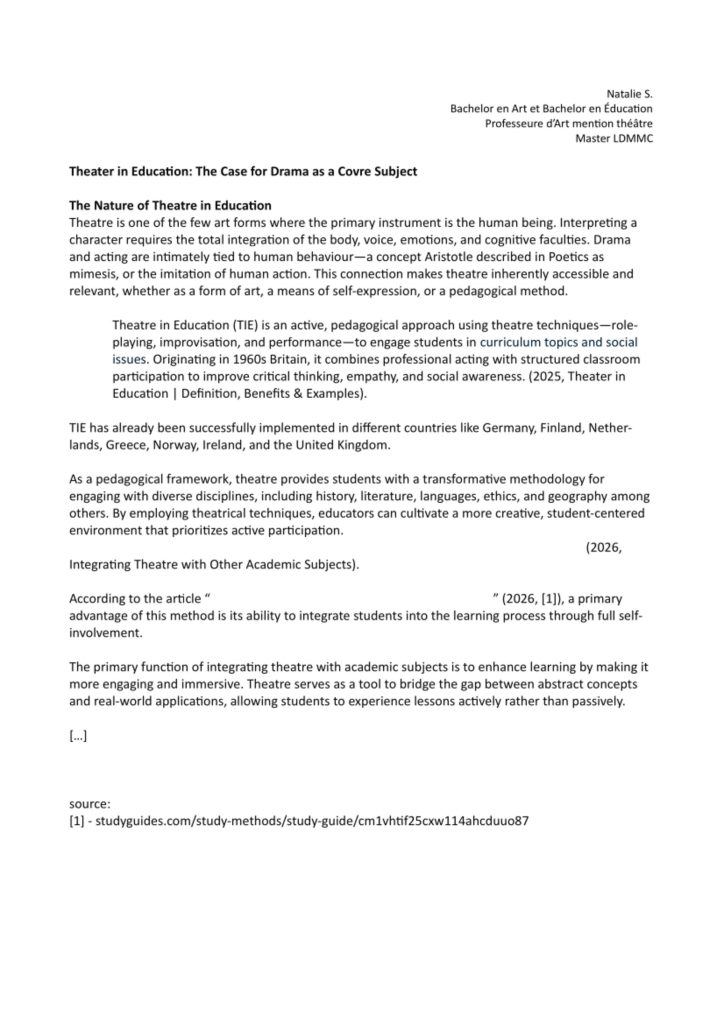
This short essay, the first page of which we are publishing here, marks the beginning of a theoretical examination of the terms ‘DRAMA’ and ‘THEATRE’ in school teaching and other educational contexts.
From the perspective of German-speaking countries, a distinction is made between ‘drama’ and ‘theatre’, and there are several essays in the literature discussing the characteristics of ‘drama in schools’ and ‘theatre in schools’. However, the website’s administrators are keen to learn about, utilise and recognise the impact of theatrical methods. We may therefore use both terms – and, in a future article, explore the differing viewpoints without becoming dogmatic. Above all, we wish to encourage teachers to engage with this topic – and ideally, this should happen on a global scale.
First and foremost, we must question the principles of learning applied in schools and educational institutions. Regular monitoring of various educational objectives reveals, with a high degree of consistency (according to one interpretative approach), a decline in results from one test to the next. Fundamental skills such as communication, team spirit, self-confidence, language skills and empathy (to name only few skills that are strengthened through performance-based methods) are not assessed, or at least not on a regular basis. This should ideally be the case worldwide.
It would certainly be worthwhile to examine teaching practices in concrete terms and to assess the effectiveness of drama and theatre-based methods. Whether ‘data analysis and business intelligence techniques’ [2] are helpful in this regard is a matter for teaching staff to decide. In any case, there is a need for incentives to shape the learning environment, to encourage learner participation, and to link these methods ‘to subjects such as literature, history and even the natural sciences’ [2]. However, this is not yet sufficiently established in today’s education system. I say this with regard to the educational region, which I know well.
(to be continued)
[2] cora.ucc.ie/items/6283dc62-3309-4e2e-848a-a5d20d372e14
McEntee, L. (2025): ‚Drama as art, pedagogy and practice: A practice-based framework for primary teachers‘, Scenario: A Journal for Performative Teaching, Learning, Research, 19(2), pp. 2-21. https://doi.org/10.33178/scenario.19.2.1
[3] intellectdiscover.com/content/books/9781783207398
Katie Dawson, Bridget Kigger Lee (2018): Drama-based Pedagogy. Activating Learning Across the Curriculum. Paperback ISBN:9781783207398